

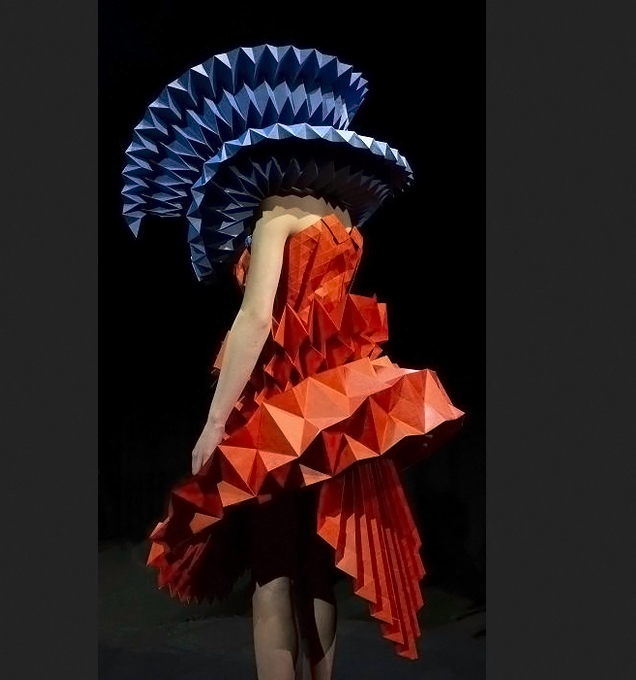
In a world dominated by industrial fashion, synthetic fabrics and fast production, from Tasmania (Australia) comes an event capable of overturning every rule of contemporary dressing.
It is called Paper on Skin and it is one of the most original international events dedicated to wearable art. Here paper, a fragile and everyday material par excellence, is transformed into sculptural garments, mobile installations and performative creations that parade on the human body.
Born in Tasmania, Australia, the event has over time become a reference point for artists, designers and creatives from all over the world. The concept at the basis of the project is as simple as it is revolutionary: to create wearable works composed largely of paper, overcoming the technical limits of a material traditionally considered delicate and temporary.
Paper on Skin is not a simple fashion show, but rather a border territory where contemporary art, theatrical costume, experimental design and performance meet. The works presented during the final gala are worn by models or performers and shown to the public in a spectacular set design, and then exhibited as true artistic installations.
The history of the event is deeply linked to the Tasmanian territory and its industrial tradition. In a region marked for decades by paper and pulp production, the event represents a form of cultural rebirth: a manufacturing past that is converted into creative energy. From an industrial material, paper thus becomes an artistic language.
One of the most fascinating aspects of Paper on Skin concerns the technical challenge imposed on artists. Creating a paper garment means dealing with concrete problems: resistance, flexibility, weight, body movement, seams, volume and stage duration. Each work requires complex design, often closer to engineering than to aesthetics. The result is surprising creations: architectural structures to be worn, nature-inspired dresses, fantastical costumes, light armours, poetic or visionary figures.
But the strength of the event is not only formal. The very title, Paper on Skin, has a powerful symbolic value. Paper recalls memory, writing, fragility, archive, possibility of transformation. Skin represents identity, physical presence, vulnerability, relationship with the world. Placing paper on skin therefore means questioning the relationship between what we are and what we show, between interiority and image, between protection and exposure.
Many artists exploit precisely this conceptual potential to address contemporary themes: environmental sustainability, climate change, gender identity, collective memory, the relationship between humans and nature. In this sense Paper on Skin shows how even a spectacular event can be a vehicle for cultural reflection.
Ecological attention is another central element. In an era in which the fashion industry is among the most impactful in environmental terms, the use of paper introduces a reflection on alternative materials, recycling and the temporariness of the object. Of course, it is not about replacing fabric with paper in everyday life, but about proposing a creative provocation: imagining a different way of producing, consuming and thinking about clothing.
Over the years the event has attracted international participants from Europe, Asia, America and Oceania, consolidating its global reputation. Winning or being selected for Paper on Skin represents for many artists a prestigious recognition, capable of opening new exhibition and professional opportunities.
What makes this event unique is perhaps its ability to hold together apparent opposites: fragility and strength, craftsmanship and innovation, local territory and international scope, spectacle and artistic research. Paper, a humble and common material, is elevated to a living art form through contact with the body.
An event that does not only celebrate creativity, but the possibility of looking at everyday objects with new eyes, of transforming what seems simple into wonder, what appears ephemeral into visual memory, what is born to be consumed into a work of art. And it shows that, sometimes, just a sheet of paper is enough to reinvent the world.
Paper on Skin 2026: finalists announced and anticipation builds for the October gala
The 2026 edition of Paper on Skin has entered its decisive phase with the official announcement of the finalists, selected after the first rounds of international evaluation. Anticipation is now growing for the major concluding event scheduled for October 2026 in Tasmania, Australia, where the works will be presented live before the public and the jury.
The designers and artists admitted to the final are currently completing their creations: sculptural garments and accessories made predominantly of paper, required to combine visual impact, technical research and performative capability.
The official schedule includes the Gala Event on 3 October, the central moment of the event with a scenic runway show and the awarding of prizes. This will be followed by a close-up showcase dedicated to the public, international workshops, and the opening of an exhibition featuring all the finalist works.
For 2026 as well, the competition confirms its global reach and a rich prize pool, with awards dedicated not only to the overall winner, but also to emerging talent, experimentation with materials, and audience appreciation.
After the success of previous editions, the final is expected to be marked by strong attention to themes of sustainability, creative recycling, and the relationship between fashion and contemporary art. Once again, paper is preparing to surprise by transforming itself into living material to be worn.