

From monumental sculpture to corrugated cardboard: the creative path of an artist who combines architecture, design, and experimentation.
He defines himself as an interior architect, sculptor, and designer: a multifaceted creative, passionate about making, inventing, and creating, using all available materials and techniques.
He works with a wide range of materials: concrete, steel, cast iron, aluminium, bronze, marble, granite, wood, polyester, polystyrene, clay, plaster, paper, and cardboard. In the same way, he experiments with different techniques: hand tools, robotics, 3D printing, CNC, waterjet cutting, and numerically controlled diamond wire cutting, as well as lathe work.
His name is Nicolas Bertoux, a French sculptor born in Paris in 1952, who has been active for many years in Italy, between Versilia and the marble region of Tuscany.
After beginning his professional career as an interior architect, he fully dedicated himself to sculpture. This shift is important because it clearly explains a central feature of his work: Bertoux does not conceive the artwork as an isolated object, but as an element capable of interacting with space, architecture, and landscape. In his own biographical presentations, the idea of integrating art into the environment frequently recurs, placing it in relation with history, local culture, and the nature of the site.
Although he is best known for large-scale stone works, limiting his practice to this aspect risks reducing the complexity of his research. In fact, the artist has experimented with various materials, including metal, wood, polyester, and, of course, paper and cardboard. These latter materials are particularly interesting because they reveal the most free, process-based, and contemporary side of his poetic exploration of paper and cardboard.
Paper and cardboard as a poetic choice
In Bertoux’s case, paper and cardboard do not appear to be “minor” or merely alternative materials. On the contrary, they become tools for reflecting on lightness, transformation, and precariousness. If marble evokes permanence, weight, and tradition, paper introduces an opposite dimension: fragility, reversibility, mobility, and speed of execution.
Exploiting precisely this contrast, cardboard also has an ambiguous nature: it is an industrial, everyday material, often intended for packaging and disposal, yet it also offers surprising structural possibilities. It can be folded, cut, layered, and assembled. In the hands of a sculptor with a spatial background like Bertoux, it becomes a kind of “poor architecture,” capable of generating complex volumes through essential means.
Cardboard works between design and sculpture
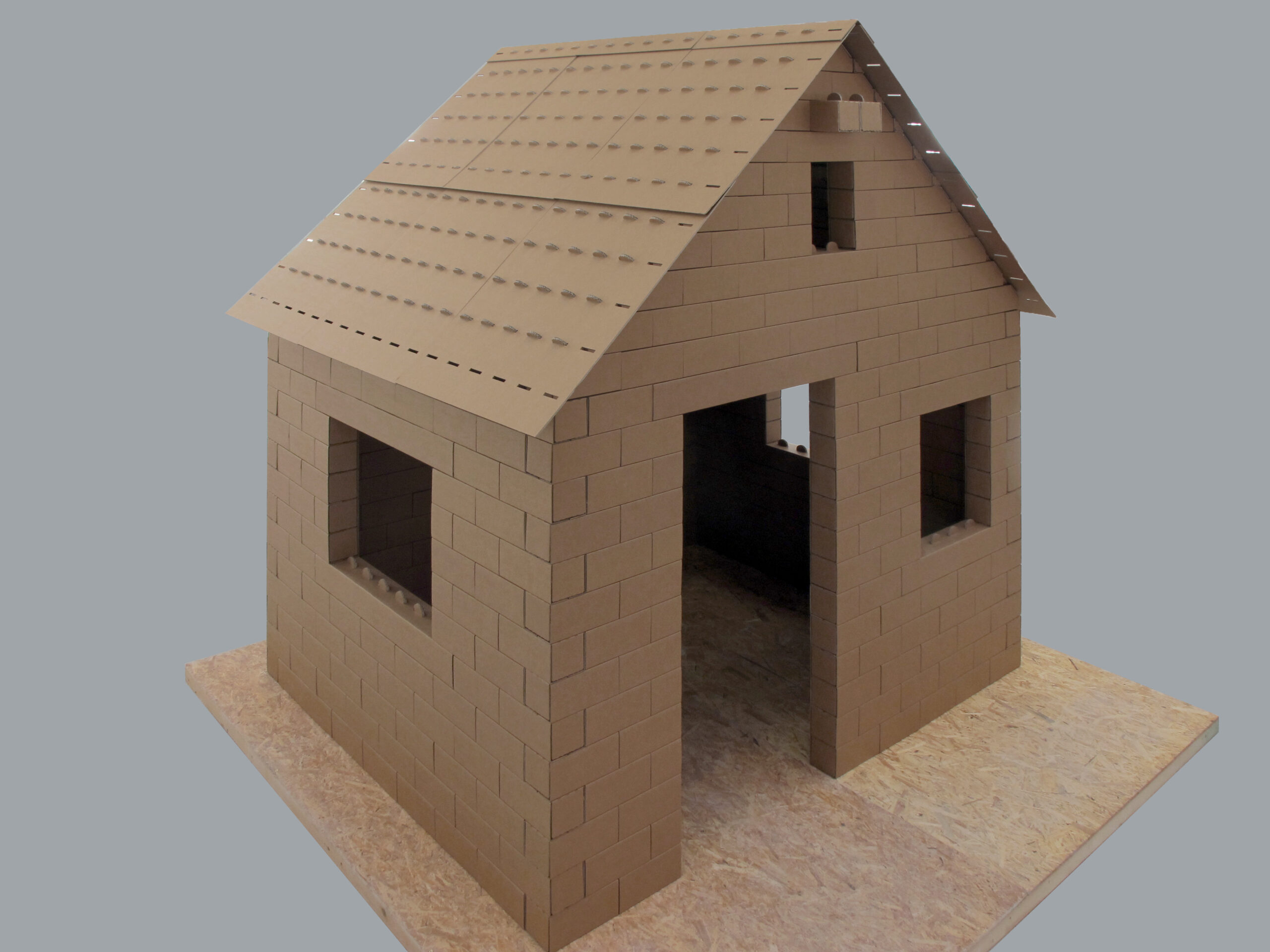
In his professional practice, there are several projects linked to this line of research, including Kart-One: a constructive and playful system made of modular cardboard units, which can be assembled, disassembled, and recycled, used to create games and structures for children, spaces and furniture for fairs and exhibitions, as well as partitions and dividing walls. Each element is made from a single piece of cardboard, easily assembled and simply mounted.
The expression brings together two opposing ideas: cardboard as a symbol of stable, heavy construction, and at the same time as a light and temporary material. It is a perfect synthesis of many tensions present in Bertoux’s work: fullness and emptiness, apparent solidity and real fragility, building and poetic invention.
The use of cardboard places Bertoux within a highly contemporary sensibility. This material allows him to address issues that are central today: sustainability, recycling, economy of means, and creative reuse. The fact that an artist accustomed to monumental works chooses a common, accessible, almost anti-celebratory material is a significant gesture: sculpture does not need noble materials to exist.
Moreover, cardboard retains traces of its industrial origin: folds, ribs, corrugated surfaces, cutting marks. All elements that can be aesthetically enhanced and which Bertoux—rather than hiding—seems to use as texture and memory of the material itself.
Relationship with architecture
His training as an interior designer emerges especially in his paper and corrugated cardboard works. These materials allow rapid modelling, volumetric study, and spatial experimentation. In this sense, they can function both as finished works and as a three-dimensional laboratory. Bertoux appears to move along both paths: on the one hand autonomous objects, on the other structures that reflect on the construction of space.
His interest in environmental context makes cardboard even more coherent: it is a material that can be assembled, disassembled, transported, and adapted. Perfect, therefore, for temporary installations and site-specific interventions.
If marble represents the most public and monumental face of Nicolas Bertoux, paper and cardboard reveal his experimental, ironic, and design-oriented side. In these works emerges an artist less tied to permanence and more interested in process, metamorphosis, and dialogue with everyday life.
The research on paper and cardboard thus reveals a strikingly contemporary Bertoux: capable of transforming humble materials into poetic structures, questioning the traditional hierarchy of artistic materials, and bringing sculpture closer to architecture, design, and common experience. It is precisely in this oscillation between monumentality and lightness that one of the most original aspects of his work lies.
On the occasion of the recent group exhibition in Biella, CARTA. The expressive power of Paper Art, we met him and interviewed him exclusively for Paper Industry World.
Can you tell us something about yourself and your story?
“I like both designing and making: I am an homo faber. I need both the intellectual side of design and the concrete side of making.
As an artist, I began working in 1973, inserting sculptural elements and bas-reliefs into architectural projects.
I am self-taught: I learned drawing from my grandfather, architecture from my uncle, sculpture from my father, and technique with my own hands.
I draw inspiration from Egypt, Greece, Rome, Mexico, but also from Le Corbusier, Louis Kahn, Carlo Scarpa, Henry Moore, Chillida, Calder, Noguchi…
I began working with corrugated cardboard to create architectural models and various constructions. Then, as my first monumental project, I designed The Labyrinth, The Paper City, first presented in Lucca (Italy) and later becoming Cartasia. A project that marked the beginning of Cartasia, which later became LuBiCa, an event still active today, for which I served as artistic director for over fifteen years, until 2020.
I use corrugated cardboard as a structural material, folding it like origami, without glue or other components. I have designed furniture, chairs, stools, tables, bases, boxes, tents, and houses”.
Kart-One: what is it about?
“I developed and patented the Kart-One construction system: modular cardboard bricks, which are assemblable, structural, made of recycled paper and always recyclable after use.
Inspired by the famous Lego bricks, Kart-One offers about twenty different modules, 100% made of corrugated cardboard, produced by die-cutting or plotter cutting. Each brick consists of a single piece of 4 mm thick corrugated cardboard, die-cut and then folded to interlock without any additional components.
The module is based on a 10×10×10 cm metric unit and then develops in linear progression (10×10×20 cm, 10×10×30 cm, 10×10×40 cm up to 10×10×180 cm), with different profiles allowing the creation of 45-degree angles, roofs, consoles, and beams. I constantly invent new modules according to project needs.
Compression tests were carried out in the laboratory by the Centro Qualità Carta in Lucca, with results exceeding expectations: one brick weighs 100 grams and supports 275 kg (later certification reduced to 70 kg for safety factors).
For the project exhibited in Biella, the bricks were cut by inmates of the Biella prison using a plotter made available to them, then packaged and assembled by students from the Carrara Academy.
I developed the project by observing cardboard boxes used for transporting and storing fruit, which are modular and stackable. Initially I created a version that required two pieces of cardboard to assemble a brick, but I was not satisfied. In the end, I found the solution that allows these bricks to be built using a single piece of cardboard”.
Have you made other works with paper? Would you like to talk about them?
“The Kart-One project has been presented several times publicly and has received sponsorship from major companies in the paper industry: Fosber, DS Smith, Lucense Paper Quality Center. I mainly produce the bricks at the Easycut Fustelle cardboard factory in Lucca.
The project has been very successful: for example, around 8,000 bricks were donated between Dynamo Camp in Limestre (Pistoia) and the Lazzareschi Foundation in Porcari for initiatives dedicated to children. We have carried out projects in Florence, Porcari, Seravezza, Massa, Biella, and Eindhoven (Netherlands)”.