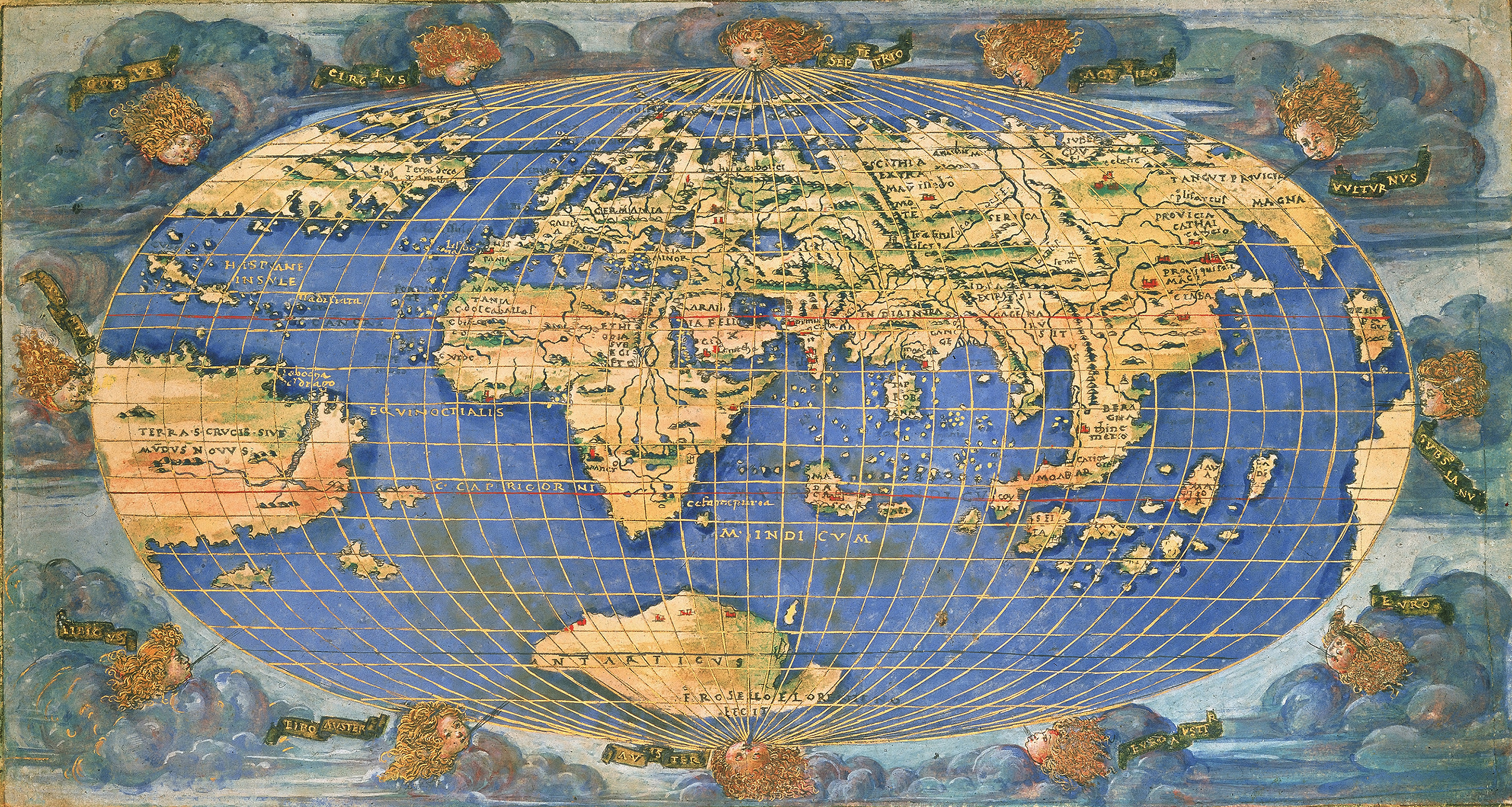
The dating of this planisphere and sea-chart depends partly upon the fact that the names given by Columbus during his fourth voyage to features in Central America, including Hispaniola and Cuba, are here shown on the Indo-China coast. This is consistent with Columbus's own belief that he had reached the coasts of Asia. This style of world map originated with Ptolemy and continued into the 17th century.
Two world maps on the same mount, probably orginally a double page from a book, laid down inside a brown leather cover and heavily hand coloured (the colouring is so heavy it was long thought to be a manuscript, in fact a method employed by contemporaries to make prints look less like prints). This is the earliest extant map to show the world in 360 degrees of longitude and 180 degrees of latitude within an oval projection, a form which would be adopted by many major cartographers later in the century. Columbus' place names for central America are placed (as claimed by Columbus) along the coast of Asia, which extends to the eastward following the Ptolemaic conception of the continent, into a peninsular North America.
The main issue for cartographers in the early sixteenth century was how to reconcile the Ptolemaic understanding of world geography with the geographical knowledge which reached Europe following the turn of the century voyages of exploration. This map is Rosselli's attempt at that feat, incorporating the latest information into a Renaissance geographical tradition. It is particularly important because it is the only extant world map by a contemporary cartographer to depict Columbus's own understanding of the geographical results of his fourth voyage.
Presentation in Florence (Italy) of the work on Italian 16th cent. cartography and topography “Cartografia e Topografia Italiana del XVI secolo. Catalogo ragionato delle opere a stampa”by Stefano Bifolcoand Fabrizio Ronca: event organized in collaboration with the local section of Unuci(National Union of Italian Officers on Leave) and Assocarta with the support of Burgo Group.
This monumental work features three volumes finely printed on Burgo Group paper, which show the 1,280 cartographic and topographic maps and over 2,500 editions described in their different versions, all made in Italy during the 16th century, i.e. the golden age of Italian cartography. The publication had been long waited for by scholars, collectors and lovers of ancient cartography from all over the world and was edited by the authors Fabrizio Ronca and Stefano Bifolco.
«Even today, in times when we have Google Maps and GPS systems, we still feel the beauty to exhibit and contemplate a valuable and fine cartographic work, as well as the practical need of having a paper map to travel all over the world and, particularly, to cross and navigate the world. Or, more simply, to find one’s way in the woods or in the mountains when one is offline», says Massimo Medugno, General Director of Assocarta.
Paper Industry World
We use technologies like cookies to store and/or access device information. We do this to improve browsing experience and to show (non-) personalized ads. Consenting to these technologies will allow us to process data such as browsing behavior or unique IDs on this site. Not consenting or withdrawing consent, may adversely affect certain features and functions.
Functional
Always active
The technical storage or access is strictly necessary for the legitimate purpose of enabling the use of a specific service explicitly requested by the subscriber or user, or for the sole purpose of carrying out the transmission of a communication over an electronic communications network.
Preferences
The technical storage or access is necessary for the legitimate purpose of storing preferences that are not requested by the subscriber or user.
Statistics
The technical storage or access that is used exclusively for statistical purposes.The technical storage or access that is used exclusively for anonymous statistical purposes. Without a subpoena, voluntary compliance on the part of your Internet Service Provider, or additional records from a third party, information stored or retrieved for this purpose alone cannot usually be used to identify you.
Marketing
The technical storage or access is required to create user profiles to send advertising, or to track the user on a website or across several websites for similar marketing purposes.