

In 2026, the Cepi Comparative Testing Service (Cepi-CTS) celebrates 50 years of service to the European paper industry. Since 1976, the program has ensured reliability and comparability in laboratory testing, becoming a key reference for quality and standardization across the entire paper value chain.
This year marks a major milestone for the European paper industry: 50 years of Cepi‑CTS, the Comparitive Testing Service that has helped ensure laboratory testing across Europe remains reliable, comparable and trusted.
Since its creation in 1976, the system has grown from a handful of test properties to more than a hundred, supporting mills, suppliers and customers with consistent, high‑quality measurement standards.
Today, Cepi‑CTS stands as a cornerstone of technical reliability in the pulp and paper value chain. Its 50‑year anniversary is not only a celebration of past achievements, but a reminder of the essential role that shared standards and collaboration play in supporting innovation and competitiveness across Europe’s paper industry.
What is the Cepi-CTS?
The Comparative Testing Service of Cepi (Cepi-CTS) is a proficiency testing scheme for the European Paper Industry. It comprises Round Robin programmes for more than 100 different test methods, covering all kinds of paper properties (strength, stiffness, structural, surface, chemical, printability, optical, tissue, labels, fibre, corrugated board, recyclability). It is used by more than 400 paper testing laboratories in most European countries; it is also extensively used outside the EU and in other industries. On average about 15000 samples are distributed every year.
It is supported by Cepi and it is run by a Working Group whose members are nominated by the national Paper Associations.
The key features of the service are:
• A fully independent service;
• The only proficiency testing scheme for paper test methods that provides samples with assigned reference values and their associated acceptable ranges of results (Warning Limits and Action Limits) so that the user can immediately asses its performance;
• Run by a Working Group that includes the most important European paper research institutes;
• Results processed in accordance with ISO/IEC 17043 and ISO 13528;
• Users comprise not only paper industries but also its clients and suppliers, with the aim to harmonise their testing procedures and achieve statistically comparable results;
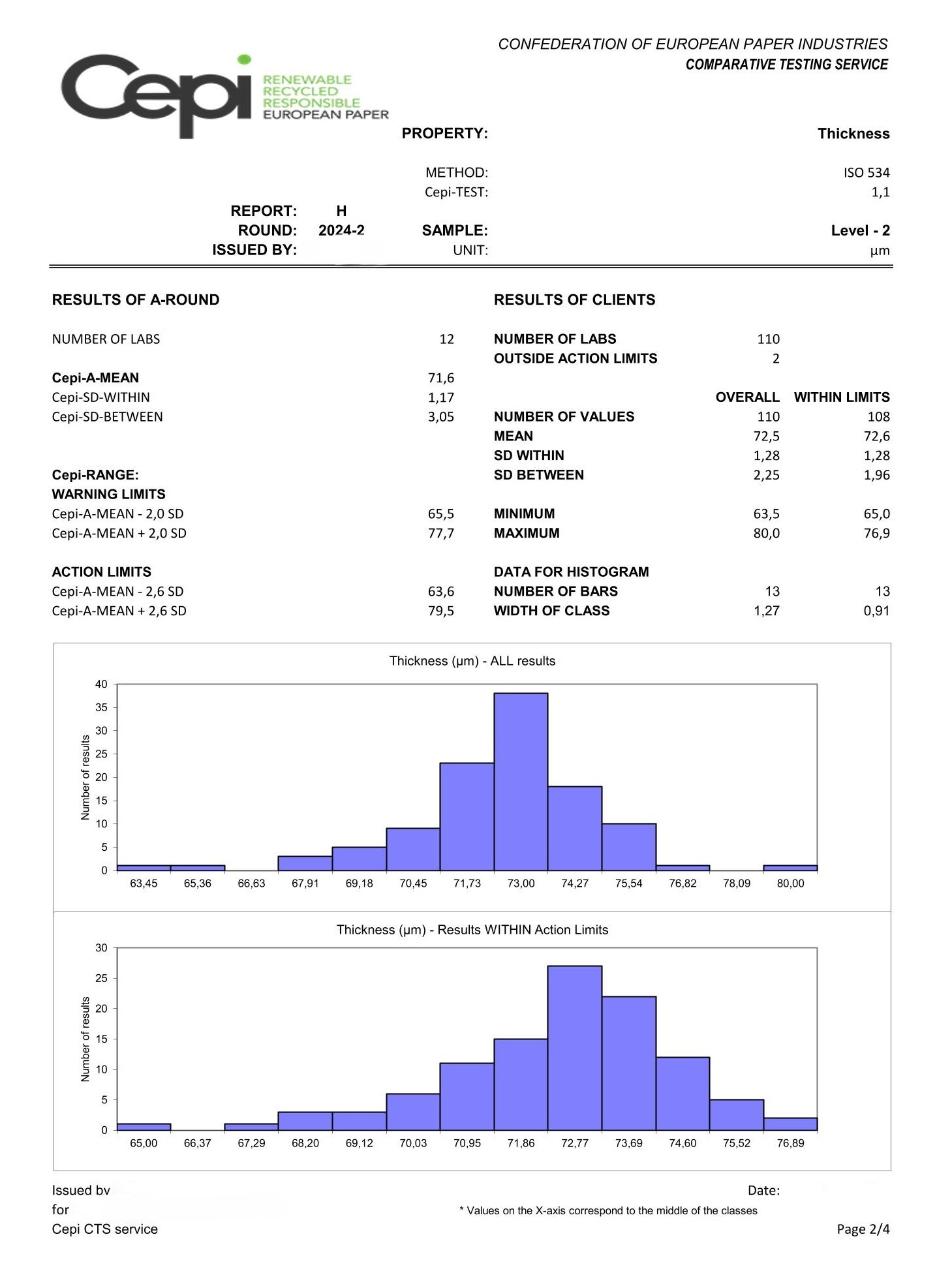
• Other deliverables include a final report that for each level of each property shows the statistical distribution of all clients (Fig. 1); personalised reports also showing the client’s z-score; a yearly Newsletter. Moreover, annual technical meetings and workshop are organized in combination with the WG Plenary Meeting, preferably close to another Paper Industry event.
• Supported by calibration, training and consultancy services.
• The Cepi-CTS is in liaison with ISO/TC 6 “Paper, board and pulps” and ISO/TC 6/SC 2 “Test methods and quality specifications for paper and board”, to which Cepi-CTS provides data to compute precision figures for its standards, and ISO/TC 130 “Graphic technology”.
The Cepi-CTS is a quantitative, simultaneous and continuous proficiency testing scheme that aims at assessing the performance of a participating laboratory against pre-established criteria by means of interlaboratory comparisons. These criteria are obtained by consensus values from expert participants. According to ISO/IEC 17043 and ISO 13528, i.e.:
• the objective is to quantify one or more measurands for each proficiency test item;
• proficiency test samples are distributed for concurrent testing by participating laboratories within a defined time period;
• test items are provided at regular intervals: the Cepi-CTS runs twice per year.
• the performance of the participating laboratories is assessed against assigned values (Cepi Assigned Value or Cepi A-Value) and their associated acceptable ranges of results (Warning Limits and Action Limits). These assigned values are determined by a preliminary interlaboratory comparison (the so-called pre-test round) of a network of Qualified Laboratories (QLs).
Confidentiality of results is assured through the use of anonymous laboratory identification.
The members of the WG that run the Cepi-CTS have one or more roles: in addition to the QLs mentioned above, the Co-ordinating Laboratories (CLs) prepare the samples, run the pre-test round, collect results, perform all statistical analysis and issue the main reports; the national Distributing Laboratories (DLs) make the CEPI-CTS available in their countries and issue personalised reports to their clients. You can find below the list of the DLs.
The range of available tests includes those typically used for process control and material specification. The samples are available in a representative range of test levels for each assessed property. The test substrates have been selected to meet a range of industrial needs, consequently, unprinted papers and boards, as well as printed papers, corrugated boards, tissue products and labels are used as sample materials.
How the Cepi-CTS works
1. Selection of sample materials
The sample materials are selected by the CLs so that the full scale of the testing instrument can be checked: for each property two or more, up to four, sets of samples are offered having different levels. These materials are tested thoroughly by the CL to get an indicative range of values for each batch of samples.
2. Pre-test round and the Report A
For each property, a pre-test round is carried out by a meaningful number of QLs, which undertake to carry out the test exactly in accordance with the specified Method or Standard (ISO, EN or possibly national standards).
After the exclusion of any statistically improbable or unreliable results, using the Cochran and the Grubbs analysis on respectively the variance and the mean of the QLs results, the Cepi Assigned Value and the standard deviation between the QLs means are calculated. The standard deviation for proficiency assessment is used to calculate the Warning limits and the Action limits. If the mean value obtained by a laboratory lies outside the Action limits, it is an ”outlier” and action should be taken to determine the causes and correct the procedures or check the instrument accordingly. If the mean value lies within these extreme limits but outside the Warning limits, it means that routines and instrument should be checked but corrective actions are not necessarily to be taken.
3. Main round and the Report H
According to its subscription plan, for each chosen property and level the clients receive from the DL the samples identified by the Cepi Assigned Value and associated Warning and Action Limits; by comparing its testing results the user can immediately asses its performance.
After returning the results and after the completion of the main Round-Robin, the clients receive the final Report H and personalised reports. The Report H shows the grand mean and total standard deviation of all client laboratory means.
This enables you to see how your measurements compare with those at other laboratories and will help you to reach a decision as to what steps you should perhaps make to improve your measurements.
The importance of Cepi-CTS as a Proficiency Testing
Proficiency testing can provide a reliable means of verifying the accuracy of laboratory tests performed by paper manufacturers, printers and converters. Laboratory testing plays a vital role in quality control and allows the efficiency of production processes to be optimised. However, errors which occur during laboratory testing can have serious implications for manufacturing and subsequent material processing. These problems are less likely to occur if the laboratory has a severe quality system in place. Essential elements of a laboratory’s quality system include external assessments of the routine testing procedures using proficiency testing schemes. Proficiency testing is an effective tool in helping laboratories to ensure that tests are correctly performed and reported.
The need for on-going confidence in laboratory performance is not only essential for laboratories and their clients but also for other interested parties, such as regulators, laboratory accreditation bodies (for example ISO 17025) and other external auditors.
If you wish to find out more about the Cepi-CTS please consult the Chairman or one of the DLs listed below.