

Ten models, sculptural dresses and paper materials, labels and packaging: at the National Museum of Science and Technology in Milan, Italy, the fashion show organised to mark the 80th anniversary of Assografici, the Italian National Association of Graphic, Paper Converting and Processing Industries, showcased the most creative side of the supply chain, bringing together art, reuse and new expressive possibilities. At the centre of the event was Caterina Crepax, who transforms materials into haute couture.
There is a moment when paper stops being just paper. It is no longer a surface on which to print words and images, a sheet to be folded, a catalogue to leaf through or packaging designed to protect a product. It becomes shape, volume and movement, transforming into a material capable of dressing the body, creating an image and telling a story. This is what happens when Caterina Crepax takes centre stage. An Italian architect and paper artist based in Milan, she has spent years exploring the expressive possibilities of a material that is as commonplace as it is surprising.
Her ability to transform paper into three-dimensional creations was one of the highlights of “Punto,” the event through which Assografici (the Italian National Association of Graphic, Paper Converting and Processing Industries) and Unione GCT Milano (the Association of Graphic, Paper Converting and Processing Industries and Related Sectors of the Metropolitan City of Milan) celebrated 80 years of activity on 15 and 16 October 2026 at the Leonardo da Vinci National Museum of Science and Technology in Milan. Ten models walked the runway wearing exclusive dresses made of paper and assembled with glue, presenting a vision of fashion in which the raw material is not merely a support but becomes the protagonist of the creative process.
The fashion show concluded the first day of the event, which was dedicated to the themes of vision and commitment. The event was designed to reflect on the present and future of the graphic arts, paper converting and processing industries, bringing businesses, expertise, culture and sustainability into dialogue. In this context, Crepax’s performance offered a distinctive perspective: demonstrating what can emerge when knowledge of materials meets imagination and the ability to look at them from a different point of view.
A passion born in childhood
To understand Caterina Crepax’s work, it is necessary to return to the origins of her familiarity with paper. The daughter of renowned comic-book artist Guido Crepax, creator of the character Valentina, she grew up in an environment where drawing and visual invention played an important role. Her passion for paper began in childhood, partly through the cut-outs from picture cards that her father prepared for her. An apparently simple activity that already contained some of the fundamental elements of her future artistic language: the pleasure of cutting, combining and assembling, and of bringing something new to life.
After completing her classical studies, Crepax explains, she graduated in Architecture from the Politecnico di Milano in 1989, with a thesis in architectural design. For more than 15 years, she worked on interior design and bespoke furniture projects, developing an approach to space based on precision, composition and the exploration of forms. At the same time, she worked on stage design and exhibition projects, experimenting with different ways of constructing images and environments.
In 1995, paper became the focus of her artistic activity. The opportunity arose when designer Nicola Gallizia commissioned her to create paper dresses for Molteni on the occasion of the Salone Internazionale del Mobile. This experience marked the beginning of a journey that led Crepax to make paper the preferred medium for her artistic research.
Her architectural training is far from incidental. It is reflected in the way she approaches paper: not merely as a surface to decorate, but as a material to design, fold, layer and transform. The sheet gains depth, takes shape in space and acquires a structure. The process involves constructing volumes, balancing proportions and studying how a form can support itself and change appearance when worn.
The result lies at the intersection of fashion, sculpture, architecture and stage design. A dress is conceived not simply as something that covers the body, but as a three-dimensional work that interacts with it. Paper, a material generally associated with lightness and fragility, thus acquires a new visual presence.
Paper as a material to sculpt
In Crepax’s work, transformation begins with a simple gesture: looking at an ordinary material and imagining a use different from the one for which it was intended. Catalogues, printed papers and other substrates can be cut and reassembled until they become elements of an original creation. The process does not necessarily erase what the paper was before; on the contrary, it can enhance its characteristics, textures, colours and images, giving them a new function.
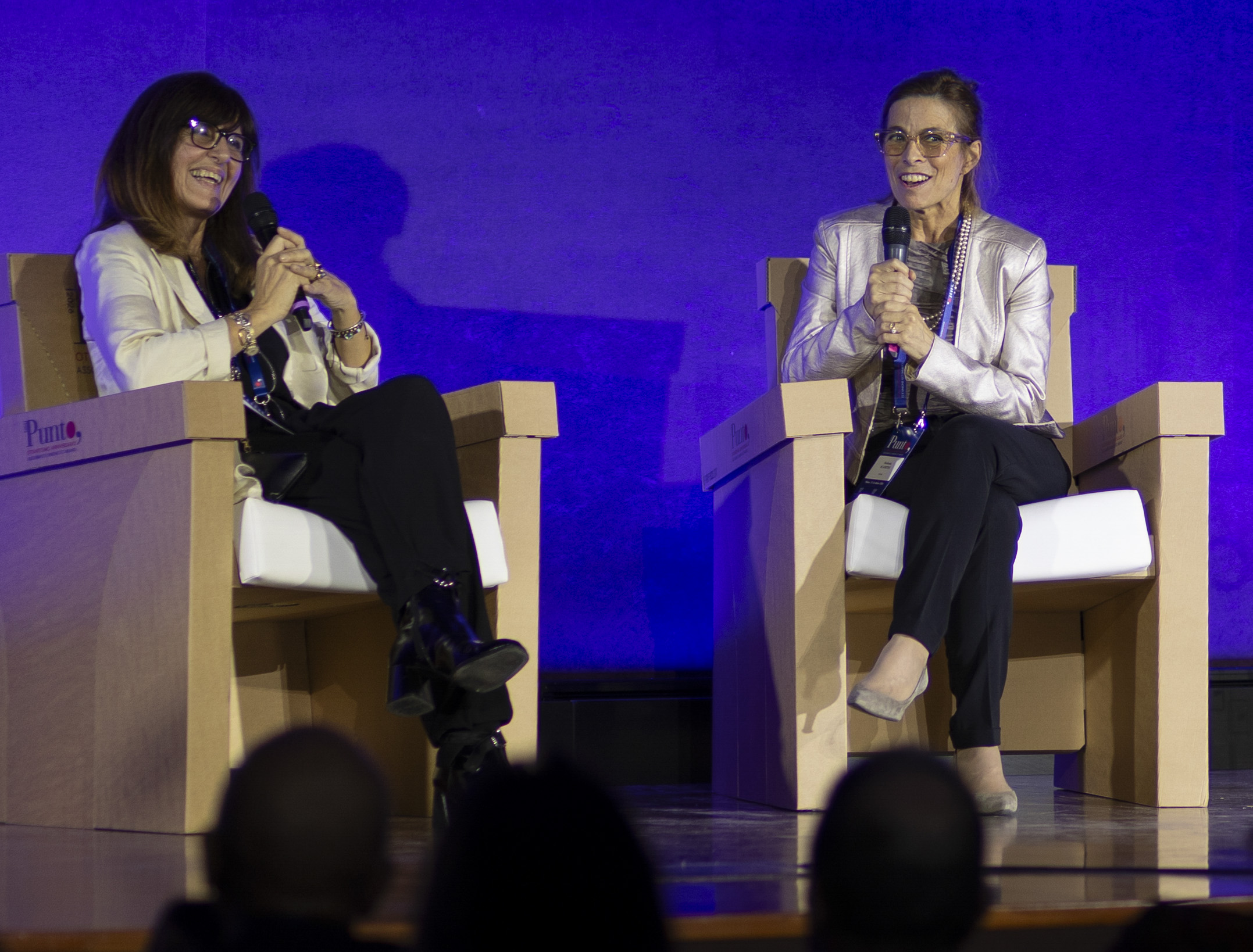
The artist explained this approach during a meeting with Stefania Scampini, marketing manager at Vinavil, who interviewed her at the Milan event. “The difference compared with a dressmaker is that she uses thread, whereas I use glue,” she explained, summing up in a single sentence the technical principle that distinguishes her work from traditional garment-making.
Glue becomes a construction tool, the means by which different elements are joined together and acquire a new identity. Cutting, folding and assembling play a role similar to that of modelling techniques in other artistic fields. A sheet of paper can become a complex structure, a decorative detail or a supporting element of a dress.
Paper, moreover, is not a uniform material: its texture, thickness, rigidity, flexibility and response to light all vary. Working with different types of paper therefore means understanding these characteristics and recognising their potential. The choice of substrate, together with the design and manual processes involved, helps determine the final result.
It is precisely this diversity that makes Crepax’s work particularly interesting to those involved in graphic arts and paper converting. For professionals in the graphic supply chain, paper is a familiar material with well-known technical and production characteristics. Crepax’s artistic research suggests a change of perspective: something designed in an industrial process to perform a specific function can become, in another context, the starting point for aesthetic experimentation.
The aim is not to oppose function to beauty, nor to disregard the technical requirements involved in production. Rather, it is to recognise that a material offers possibilities beyond its most immediate application. Printed paper can be read, but it can also be appreciated for its texture, colours, the way it folds and the effect it produces when assembled with other elements.
Ten models to present a different vision of fashion
On the evening of 15 October 2026, at the Museum of Science and Technology, this research took the form of a fashion show, demonstrating how paper can move from the worktable to the public setting of the runway. The dress acquires meaning through the body, space and movement.
The choice of a fashion show is significant: a garment also exists in relation to the person wearing it. It changes perspective, moves, occupies space and is seen from different angles. In the case of paper dresses, this relationship becomes particularly interesting because the material is not one normally associated with clothing. Its presence immediately makes visible the design work behind each creation.
The runway thus becomes a meeting place for artistic research and the world of fashion. A dress does not necessarily have to meet the same requirements as a garment intended for industrial production and everyday use. It can explore unusual shapes, emphasise its sculptural dimension, highlight the relationship between surface and volume, and push the material beyond conventional expectations.
It is in this space of freedom that paper reveals its ability to surprise. We are accustomed to considering it fragile, easily folded and often destined to be used and then replaced. Crepax brings another dimension to the fore: through design and craftsmanship, paper can become the protagonist of a complex aesthetic language.
The fashion show therefore represented more than a spectacular interlude within an anniversary celebration. It was also a practical demonstration of how creativity can expand the range of applications for a material and change the way we perceive it.
From printed paper to dresses: the value of the supply chain
For Assografici, which represents Italy’s graphic arts, paper converting and processing companies, the decision to entrust Crepax with one of the concluding moments of the first day carried particular significance. Paper is the starting point for many industrial activities, from publishing and catalogue production to labels and packaging. It is a material that supports communication, the circulation of information and the presentation of products.
Labels, cardboard boxes for shipping wine, wrapping paper, barcodes and threads made from newsprint: the Milan fashion show highlighted the variety of materials supplied by companies across the industry and used to create the dresses. These included paper offcuts from Grafiche Tassotti, wallpaper samples from Jannelli&Volpi and paper feathers from Cartiere Fedrigoni, used to create the wedding dress, one of the evening’s most precious pieces. The materials were often assembled using Vinavil glue, which also gives the paper a striking wet-look effect. The creations also convey a sense of playfulness and enjoyment, with shapes, volumes and details evoking different eras in a free dialogue between imagination, fashion and materials.
The dialogue between production and artistic creation thus took on a tangible form: materials associated with companies’ everyday work became part of an expressive project.
This encounter makes it possible to look at the sector beyond its purely productive dimension. Behind a sheet of paper, a label or a package lie technical expertise, research, design, knowledge of materials and industrial processes. Using these same materials in an artistic context brings to light a wealth of characteristics that often remain in the background when a product is considered solely in terms of its end use.
For companies, this kind of dialogue can also be an opportunity to highlight the material culture of the supply chain. The quality of paper is not limited to its ability to be printed or converted. It also encompasses how it responds to processing, its visual and tactile qualities, its potential to be combined with other elements and the way it can help define an object’s identity.
Art can offer a way to communicate the potential of industry, highlighting aspects that do not normally feature in technical or commercial communication. Creativity thus becomes a tool for making the qualities of a material understandable, even to a non-specialist audience. This dialogue also brings sustainability into focus: transforming everyday paper materials into artistic creations highlights the value of reuse and the possibility of giving a new function to materials that have already been produced.
A language spanning art, fashion and design
Caterina Crepax’s career demonstrates how research centred on a specific material can develop a distinctive language and engage with different worlds. Throughout her career, the artist has collaborated with leading names in fashion and design, including Roberto Cavalli and Fendi, and has presented her work in exhibition venues such as the Triennale and the La Scala Museum.
Alongside dresses, her work also includes tapestries, animals, miniature theatres and other three-dimensional creations. These different forms share a common aim: to give paper a sculptural and narrative presence. The material is chosen not only for what it makes possible from a technical standpoint, but also for its imaginative potential.
One element links her architectural training to her artistic practice: the ability to build. Whether she is creating a dress or a three-dimensional object, paper is organised in space through a series of design decisions. The result emerges from a balance between intuition and technique, and between the freedom of invention and the material’s physical limitations.
The manual dimension remains central: every cut and every joint contributes to the final form, and every choice alters the balance of the whole. The work therefore requires practical knowledge of the material, as well as the ability to envision the result before it takes shape.
This approach can also resonate with an industrial sector accustomed to addressing innovation in processes and products. Artistic experimentation and industrial production have different objectives, but they share common ground: knowledge of material properties and the search for solutions capable of meeting a design brief.
For a sector whose history has been built on the ability to transform fibres, inks and surfaces into tools for communication, culture and protection, the fashion show was also an invitation to look ahead without losing sight of its identity. Eighty years of experience can become a starting point for new possibilities, provided technical expertise is accompanied by openness, curiosity and imagination.
On the runway, paper demonstrated that it can take on an unexpected form. Beyond the runway, the challenge remains to continue discovering its potential through research, design and applications that have yet to be imagined.