

There is a dance the audience rarely sees. It is not the one that inhabits the stage, illuminated by spotlights, but the one that lives in the silence of rehearsal rooms, in corridors, in gestures repeated endlessly, in waiting and concentration. It is to this invisible dance that last autumn the exhibition Lo sguardo nascosto – La danza dietro il sipario, hosted at the Museo Teatrale alla Scala, chose to devote its narrative.
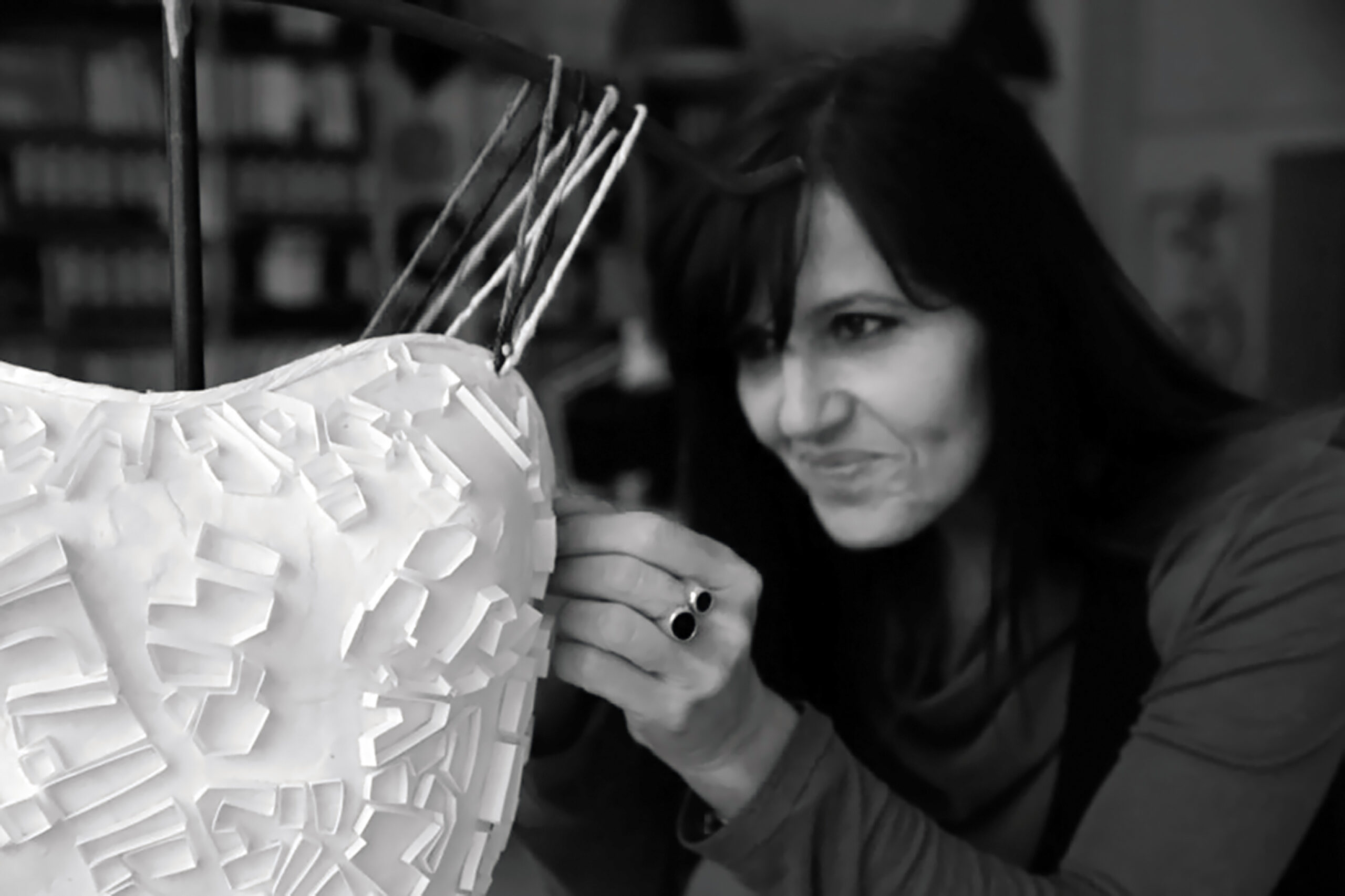
Within this exhibition path, Ballerine di carta by Caterina Crepax takes shape as a true show within the show: a poetic intervention that does not document dance, but evokes it, suggests it, and transforms it into fragile, lightweight matter.
Behind the curtain
The exhibition project stems from the photographic work of Gérard Uféras, who follows the Ballet Company of the Teatro alla Scala away from the stage. His images convey the everyday discipline of the dancers: tired bodies, focused gazes, moments of intimacy and connection that precede or follow the performative act. It is a respectful and silent gaze, one that does not seek the exceptional gesture, but its humanity.
In this context, dance no longer appears as pure aesthetic perfection, but as a process — continuous work on the body and on time. Beauty emerges precisely from what usually remains hidden: fatigue, repetition, vulnerability.
Paper ballerinas: lightness and memory
The works of Caterina Crepax enter this narrative with a different yet deeply coherent voice. Her Paper Ballerinas are light sculptures — tutus and pointe shoes suspended in space, made entirely of paper. Iconic ballet objects are stripped of their function to become symbolic forms, traces of an absent yet evoked body.
The choice of paper is not accidental: a fragile, ephemeral, seemingly humble material that is nevertheless capable of preserving memory and movement. The sculptures do not imitate the ballerina’s body, but suggest its presence through what surrounds, supports, and disciplines it. It is a negative dance, composed of voids and silences.
A dialogue between the visible and the invisible
Inserted into the exhibition path, the Paper Ballerinas engage in dialogue with Uféras’ photographs, creating a continuous interplay between presence and absence, between the real body and the imagined one. If the images show dancers in their everyday concreteness, Crepax’s works restore the most intimate and symbolic dimension of dance.
The paper tutu, motionless yet vibrant, seems to hold the gesture just completed — or the one still to come. The pointe shoe, deprived of the foot, tells the story of the invisible labor that precedes every perfect step. In this sense, the works become a powerful metaphor for dance itself: an art founded on the constant balance between strength and fragility.
An artistic genealogy
Caterina Crepax’s work also carries a dimension of family and cultural memory deeply connected to La Scala. Daughter of the comic artist Guido Crepax and granddaughter of Gilberto Crepax, longtime cellist of the Orchestra of the Teatro alla Scala, the artist intertwines architecture, visual art, and the musical world in her personal path.
Paper Ballerinas are therefore not only a tribute to ballet, but also an act of continuity and belonging: a way of inhabiting tradition without reproducing it, transforming it into a contemporary gesture.
The Hidden Gaze invites visitors to change perspective, to slow their gaze and linger where one usually passes by. Within this framework, Paper Ballerinas acts as a poetic pause, a suspended moment. Here, dance is no longer only movement, but trace, memory, echo. It is what remains when the body stops and the gesture settles into space. A fragile dance, like paper, yet capable of enduring precisely because of its lightness.
The presence of Caterina Crepax and her paper ballerinas added a strongly evocative and poetic element to the exhibition: an original way of representing dance not only as a visual phenomenon, but also as a sensory and metaphorical experience. This element contributed to creating a dialogue between memory, matter, and movement, making the exhibition one of the most fascinating interpretations of the ballet world in recent years.
For Caterina, an unexpected encounter with dance: from zorro to dragonfly
“I knew absolutely nothing about dance, because I never practiced it,” Caterina recounts. “As a child I was a tomboy — I dressed up as Zorro and was very far from the idea of a ballerina. Yet, almost by chance, just as I was thinking about how to create the exhibition, I came across the story of Carla Fracci on RaiPlay. I watched it and was moved — such a beautiful story.
From that moment I fell a little in love with it, and in fact the next day I designed the dress dedicated to her, made with dragonfly wings, because Carla Fracci was known as ‘the dragonfly of dance.’ Then I went to Rita Citterio, at La Scala’s costume workshops at the Ansaldo, who opened the doors to this wonderful world of tutus. I went to look at them, to study them, to understand how many layers they had and how they were constructed.
It was a great discovery, which brought me closer to a world that until then had felt very distant.”
The book release
The work of Gérard Uféras is also at the center of a volume edited by Paola Calvetti, published by Il Saggiatore together with the Edizioni della Scala, scheduled for release in bookstores at the end of February 2026.
The book gathers 160 photographs, divided into two sections: one in black and white, mainly dedicated to rehearsal work, and one in color, accompanying the reader onto the stage. Paola Calvetti curated the volume and wrote the text on the relationship between the photographer and dance, while Valeria Crippa explores the history and characteristics of the Ballet Company of the Teatro alla Scala.
Quiet and discreet, Uféras observes the dancers up close and captures that special humanity that usually escapes the audience’s gaze. His images reveal what normally remains invisible, moving beyond the idea of a world made solely of perfection and grace.
His lens lingers on details, unexpected moments, and minimal gestures that compose a sort of choreography of everyday life. In these spaces — inhabited by bodies trained to precision and lives lived as if on a permanent stage — the unforeseen becomes an integral part of the narrative.
This is therefore not merely a photographic feature dedicated to La Scala’s Ballet Company, but the documentation of a human and artistic journey. Uféras follows the company into the theater’s less visible spaces: the rehearsal room, the stage before the lights come on, backstage — offering an intimate and authentic portrait of the dancers’ lives.
The volume also fills a significant editorial gap. Until now, the only publications available on La Scala’s Ballet Company were the book by Luigi Rossi, Il Ballo alla Scala 1778–1970, published by the Teatro’s own editions, and a 2022 Special Issue of Rivista della Scala produced by the Press Office — both now out of print.