

The digitalization of energy consumption, combined with heat recovery technologies, compressed-air optimization and energy storage, can help reduce costs and emissions in the paper industry. Data monitoring also makes it possible to identify inefficiencies and target specific interventions with short payback periods.
Reducing energy consumption and emissions, achieving greater control over operating costs and improving plant efficiency are objectives of modern industry, and even more so of the Italian paper industry, which pays significantly higher energy costs than its international competitors. In addition to being priority objectives, all these factors are also strategic tools capable of supporting the transition of the paper sector. Based on these considerations, Giorgio Rossini, Sales Manager Southern Europe at Hitachi – Industrial Equipment Systems, illustrates the approach and technologies developed by the Japanese group to support decarbonization and energy efficiency in the paper industry. This topic was the subject of a study conducted by Pier Luigi Zilio, Energy Efficiency & Sustainability Group Manager at Hitachi, and presented by Rossini at the Aticelca 2026 Congress.
Paper mills and energy consumption
The manager, recalling that the paper industry is among the energy-intensive manufacturing sectors, provides some figures: “Approximately 60% of the energy used in paper mills consists of thermal energy, while the sector accounts for around 2% of total industrial emissions in Europe.” He also acknowledges that the sector has already made significant progress in terms of energy efficiency. “In recent years, there has been a reduction of approximately 25% in specific consumption per tonne produced, mainly thanks to the widespread adoption of cogeneration and the optimization of production processes.”
Despite these results, however, many production plants and paper machines are obsolete and therefore inefficient. “In some mills, heat recovery systems are insufficient or not fully exploited, while electric motors and auxiliary equipment are not always optimized for the specific operating conditions of paper mills.” Added to this, Rossini continues, is the evolution of raw materials. The increased use of recycled paper leads to a growing presence of contaminants requiring cleaning and refining processes, which contribute to higher energy consumption. This also results in increased process waste and intensive use of water resources, with a consequent rise in operating costs and management complexity.
H-Vision: an integrated approach and dedicated portal
To address these challenges, Hitachi proposes a working model that combines different technologies aimed at reducing consumption and emissions.
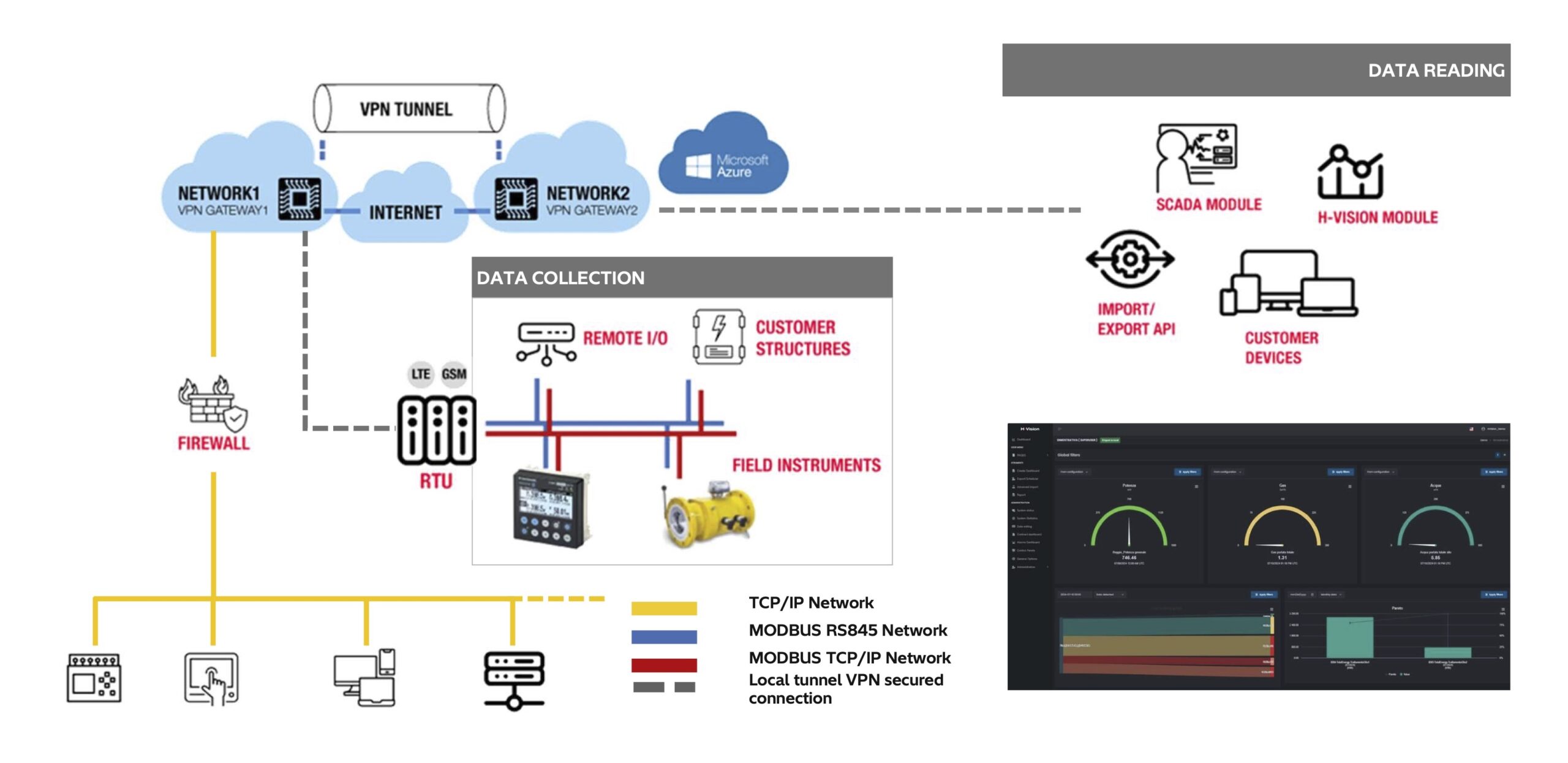
“The main technological levers we work on are heat recovery, cogeneration and trigeneration, high-efficiency industrial heat pumps and compressed-air systems. Completing this ecosystem is digital energy monitoring, which is one of the fundamental tools of our offering,” explains Rossini. Hitachi’s approach is based on the idea that any efficiency improvement initiative must start with an in-depth understanding of actual consumption data and its correlations with the production process. Energy monitoring therefore becomes a central element of a decarbonization strategy. Specifically, the method referred to by the manager is called H-Vision. “It represents the way we work and our philosophy,” he states. It is based on an integrated approach aimed at improving energy efficiency and sustainability through data analysis. “By combining an advanced cloud-based monitoring system with industry expertise, it transforms raw operational data into useful and actionable knowledge.” Once implemented, the method enables companies to identify inefficiencies and optimize resource consumption.
The platform architecture is designed to integrate with existing infrastructure and collect information from all the utilities present at the plant.
“Data relating to every type of consumption is acquired: electricity, water, steam and other utilities. Everything is correlated with production data, so as to obtain not simply the number of kilowatt-hours consumed or the amount spent, but the specific cost associated with the product manufactured.” This therefore makes it possible to accurately measure energy costs and identify the areas where action should be taken to improve efficiency.
However, the value of the system is not limited to energy optimization. “H-Vision is also a governance tool. It provides reliable data to production, operators and company management, enabling decisions to be made based on objective information. It also helps foster a culture of efficiency and sustainability within the organization.”
Compressed air: efficiency in the paper mill
A technology that has historically been part of Hitachi’s portfolio concerns compressed air. “Compressed air is part of the company’s DNA. Hitachi was founded in 1910, and the first compressor manufactured in Japan dates back to 1911,” Rossini recalls. The acquisition of the US-based Sullair group in 2017 further strengthened the group’s presence in this market segment, bringing to Europe technologies developed for demanding industrial applications that are perfectly suited to the needs of the paper industry. One of the distinctive features of Sullair compressors is the air-end, which is larger than those currently standard on the market. “The air-end is approximately 10–15% larger than that of many competitors. This allows for greater heat dissipation and better load distribution, consequently ensuring greater reliability over the long term.”
Alongside this technology is the spiral valve, a proprietary Hitachi Sullair patent. “The spiral valve makes it possible to modulate the compressor’s output without using an inverter installed on the machine. The output variation takes place through a mechanical system controlled by the compressor’s electronics, while maintaining a constant motor speed.” This solution, Rossini points out, offers significant advantages under the operating conditions typical of paper mills, characterized by high levels of dust, humidity and particularly demanding environmental conditions. The absence of the inverter eliminates one of the most sensitive components of the entire system under such conditions, resulting in a further improvement in compressor reliability.
In addition, Hitachi Sullair compressors are equipped with ERS (Energy Recovery System) technologies that recover the heat generated during compression through a water-oil heat exchanger. The recovered energy can be used to preheat process water or for other thermal applications within the plant.
Energy storage using liquid air
Another interesting Hitachi innovation is Prisma, a technology developed and patented by Innovatium, a Scottish company acquired by the group.
The system uses LAES (Liquid Air Energy Storage) technology, based on storing air in cryogenic liquid form. Energy is stored during periods of lower cost or lower production demand and then made available when needed.
“Air can be produced and liquefied during nighttime hours or when energy demand is low, and then used when required,” explains Rossini. Applications include covering consumption peaks, when existing compressors are insufficient to meet demand in emergency situations; supporting existing compressed-air systems; reducing compressor use during the most expensive hours; and generating energy through dedicated generation systems, with the resulting energy savings. The modularity of the solution also makes it interesting for integration with, for example, renewable energy sources or systems that provide greater energy flexibility.
From data to action in industry
The effectiveness of Hitachi’s system has also been verified in the field. Several application cases have adopted the monitoring-based approach, demonstrating how the system can be adapted to different industrial contexts.
One initial project involved an industrial water treatment and recovery plant developed following analyses carried out through H-Vision. Rossini explains that the system, consisting of microfiltration and reverse osmosis modules, was designed on the basis of a measurement campaign conducted using a pilot plant installed on site.
With a treatment capacity of 60 cubic metres per day and removal rates of more than 97% for COD and 99% for surfactants, “the plant reduced disposal costs by 30% and the volume of wastewater discharged into the sewer system by 40%, returning the treated water to the production cycle. The investment payback period was approximately three years.”
A second example involved a tyre manufacturer. Consumption monitoring identified a production line characterized by lower energy performance than the others. “Replacing a direct-current motor with a permanent-magnet motor resulted in a 47% reduction in consumption, a 48% increase in performance and a payback period of less than twelve months,” the manager recalls.
Another significant case involved an industrial pumping station. After four months of continuous data collection, the analyses revealed inefficiencies related both to operating conditions and to the plant configuration, which consisted of four 75 kW centrifugal pumps. “Fully opening a partially closed valve, installing a pressure sensor to control two inverters and reduce outlet pressure, and replacing the motors with high-efficiency models, together with upgrading the piping system, increased the average efficiency of the pumps to 66%, reducing electricity consumption by 15% and generating annual savings of approximately €81,000.”
Another project involved a process industry plant characterized by high steam consumption. Six months of monitoring made it possible to accurately quantify the cost of inefficiencies in the distribution network. “In this case, relatively simple measures were implemented. Restoring the insulation on the pipes and systematically identifying leaks resulted in a 28% reduction in steam consumption and energy savings of more than €150,000 per year.”
Focus on the paper industry
Hitachi’s technology applications most closely related to the paper industry mainly concern compressed-air systems installed in paper mills in Veneto and Tuscany, with units ranging from 132 to 250 kW. The spiral valve technology has made it possible to adapt compressed-air delivery to fluctuations in production demand, managing variations of up to 50% of the required power without using frequency converters. This feature is particularly well suited to demanding production environments, such as those typical of the paper industry.
“We follow the entire value chain,” Rossini points out, “from paper production to bookbinding, from printing plants to book and magazine packaging. We have dozens of installations in the paper sector and hundreds of machines operating in other industrial sectors.” The units currently available cover power ratings of up to 355 kW and can be configured modularly to adapt to the specific requirements of each plant.
In essence, for the paper industry Hitachi proposes an integrated decarbonization model based on digitalization, energy efficiency and technological innovation, with the aim of combining emissions reduction, industrial competitiveness and economic sustainability.
“Our focus is on the paper industry, but also on cement plants and glassworks, that is, sectors where production continuity is essential and plant downtime has particularly high costs,” the manager emphasizes. Beyond the specific characteristics of each individual installation, application cases in different industrial sectors demonstrate concrete and interesting results. Overall, energy consumption reductions of up to 40–50% have been recorded, together with improvements in operational performance and production continuity, significant annual cost savings and a return on investment averaging between one and three years.